
Outcome-based Pricing in Practice: What Outcomes Are AI Companies Really Charging For?
Current outcome-based pricing applications for AI products from Zendesk, HubSpot, and Salesforce show that clearly defining outcomes can be challenging.

Summary. Outcome-based pricing promises that customers pay only when an AI agent delivers a result, but the cases of Zendesk, HubSpot, and Salesforce show that the hard part is defining the outcome itself. What counts as a resolved ticket or a qualified lead is often subject to different conflicting interpretations, can favor the vendor, and be difficult to verify. Until the priced outcome closely and conclusively matches the customer value delivered by the AI product, outcome-based pricing will remain unsettled and have to coexist with other price structures.

The Customer Experience VP at a fast-growing online furniture retailer signs a contract with an AI vendor that charges $2 each time an AI agent resolves a customer issue. At first glance, this appears to offer excellent economic value. The customer service team handles a steady flow of delivery questions, return requests, damaged-item complaints, missing hardware claims, and warranty issues. These issues are repetitive, arrive around the clock, and are significantly more expensive to handle with human agents.
The logic behind this outcome-based price structure is simple and appealing: pay-for-performance at its purest. If the AI agent resolves the customer’s issue, the vendor gets paid. If it does not, the case is handed off to a human agent without incurring a charge. Additionally, this seemingly prototypical outcome-based price structure slots neatly into the CX group’s ongoing initiative to add AI capabilities to its workflows.
However, a closer inspection reveals a far more complicated and less positive picture. For billing purposes, the vendor counts an issue as resolved once there is no further communication for 72 consecutive hours, after making an automated AI-based evaluation. The problem is that neither silence nor automated checks can distinguish a satisfied shopper from a quiet defector. In this framework, a shopper who gives up and buys furniture from a competitor counts as a resolution. So does the loyal customer who decides the return is more trouble than it is worth and walks away, with a low opinion of the brand’s CX. Both conversations peter out in the company’s channels, both pass the AI check, and both incur a $2 charge, defined in the contract as successful resolution.
As this hypothetical case study illustrates, the pricing conundrum with outcome-based pricing lies in the outcome at least as much as in the prices. Defining usage in a traditional usage-based contract is usually straightforward, but defining the outcome in an outcome-based contract is often quite complicated. The vendor and the customer can look at the same features and benefits of the service and reach very different conclusions about the outcome. This also applies to different customers across the base, which means the vendor will have to grapple with a wide range of outcomes and their respective nuances.
Outcome-based pricing, familiar from pay-per-click in digital advertising and pay-per-lead in B2B sales, is now being seriously considered and included in many AI pricing structures due to the underlying economics. Specifically, AI agents often have substantial incremental costs associated with their use, which makes it difficult to apply traditional SaaS price structures built on minimal incremental costs. Per-seat pricing from SaaS doesn’t work well because it relies on the outdated assumption that a human is doing all the work, severing the link between the price and work done, and often leading to underpricing AI offerings. Token pricing in its current form is problematic because it is cost-based in the crudest way possible and does not map onto customer use or customer value. Furthermore, it is hard to budget for or justify internally for the organization (e.g., what should the budget be and why?). Credit-based pricing meters usage, but is like a loyalty program in the sense that the number of credits and conversion rates are controlled by the vendor and are subject to devaluation.
Outcome-based pricing potentially fixes these limitations of emerging AI-based pricing structures by focusing on more explicit measures of customer value, such as a resolved ticket or the number of lines of code written, or some other metric of relevant customer behavior. The AI product’s benefits can be linked more directly to downstream outcomes and, eventually, to the customer’s financial performance. However, outcome-based pricing also raises a significant challenge I want to focus on in this piece: the question of price legibility, by which I mean the extent to which the customer can understand what the unit of the priced outcome represents, forecast how much of it they will incur, and explain the resulting amount billed by the vendor. Note that the price legibility concept, as developed here, is distinct from price transparency. Price transparency has to do with disclosure, whereas price legibility has to do with interpretation and understanding. For example, a token bill from an AI service provider may disclose the number of units consumed and the rate per token, yet leave the customer befuddled about the value received.
At first glance, customer-relevant outcomes considered for outcome-based pricing seem highly legible in the sense that a resolved ticket or a booked call appear to be reasonable and unambiguous, and seem to correspond with customer value. The challenge lies in the fact that price legibility on the surface may belie its real complexity underneath. For a resolved ticket, for example, what exactly constitutes resolution, and, even more importantly, what evidence of resolution that both vendor and customer can agree on, are far more difficult than simply naming the outcome as resolution. To explore this issue in detail, I will consider three current outcome-based pricing structures in the marketplace: those involving Zendesk, HubSpot, and Salesforce.
Zendesk
Zendesk’s current price structure, introduced in April 2026, provides a prototypical example of resolution-based pricing in the market at the moment1. It is very similar in form to the furniture retailer example. Its AI agents bill per automated resolution, costing the customer approximately $2 per resolution under a pay-as-you-go arrangement and approximately $1.50 per resolution under a committed volume arrangement. The company’s automated resolution uses AI tools to remove humans from the resolution process throughout the customer interaction process, with the goal of eliminating human labor costs. The customer only pays when the problem is resolved without human intervention. Problem resolution is inferred using multiple signals. A user may confirm satisfaction or accept a suggested help-center article, which is taken as an active signal of resolution. When this is not available or not feasible, inactivity is used as the cue for resolution in some channels. After 72 hours2, the conversation is considered provisionally resolved, with a separate AI evaluation model reviewing the transcript before the resolution is recorded.
The timing for determining resolution is a key definitional issue in this case and is subject to debate. As pointed out earlier, a customer who simply gave up the conversation as futile and a customer who was assisted will both appear as inactive for 72 hours, and the verification of one as a failed resolution versus the other as a success is very difficult. An authentic confirmation would require successful verbal follow-ups with both customers, something that is unlikely given low response rates. Thus, using a 72-hour cut-off as the relevant billing outcome can favor the vendor at the customer’s detriment if the inactivity is misclassified as resolution. Complicating things further, across different customers, this simplification may have varying levels of detriment depending on the nature of the customer service delivered through Zendesk.
HubSpot
HubSpot’s pricing offers a useful counterpoint to Zendesk’s, as it charges for two different AI agents based on different kinds of outcomes3. These agents are used to complete marketing, sales, and customer service tasks such as responding to inquiries, resolving problems, and providing service support (Breeze Customer Agent), and watching for buying signals, finding contacts, and personalizing outreach (Breeze Prospecting Agent). In April 2026, its Breeze Customer Agent moved to an outcome-based pricing of $0.50 per resolved conversation, down from $1 per handled conversation. Communicating this shift to outcome-based pricing as a “move to outcome-based pricing, meaning customers only pay when the agents complete the task it’s been assigned,” the company now charges only when a conversation is completed without a human handoff, again typically measured against a window of inactivity. At the same time, its Breeze Prospecting Agent moved to $1 per lead recommended for outreach, replacing a prior recurring monthly fee for enrolling and monitoring contacts for prospecting.
This is an interesting expansion of outcome-based pricing from an outcome that involves conversation resolution (like Zendesk) to one that involves handing over a qualified prospect to the customer. We can argue that where downstream value to the customer is concerned, a resolved conversation is more cut-and-dried than a prospect, given the opacity of the qualification process, especially when AI is involved. Specifically, the prospect’s qualification is based on the AI agent’s judgment without any weight given to whether the prospect actually turns into a customer. Stated differently, under the new outcome-based pricing structure, HubSpot is asking customers of two of its key AI-enhanced offerings to pay for them using qualitatively different outcomes (one much more verifiable than the other).
A final point is worth noting. While the shift is positioned as a price cut and will, in fact, lower the bill for many Customer Agent users, it converts what was previously a fixed cost, i.e., a recurring subscription fee, into a variable one, particularly for the Prospecting Agent. Whether a given customer ends up paying more or less for the value received is no longer clear in advance.
Salesforce
The third case I will examine here is Salesforce’s recent multi-layered adoption of outcome-based pricing. It’s an excellent illustration of how unsettled AI pricing structures currently are, both with respect to preferred structures and the choice of outcomes when using outcome-based pricing4. Agentforce, Salesforce’s platform of AI agents built into its CRM, launched in late 2024 with a flat price of $2 per conversation, defined as a 24-hour session between an agent and a user, regardless of the number of actions involved. The company then introduced an alternative price structure, Flex Credits, charging approximately $0.10 per standard Agentforce action; a single conversation might consume anywhere from a handful to dozens of actions. Finally, it added the traditional SaaS per-user licensing price structure as a third option for its customers, with a list price of $125/user/month.
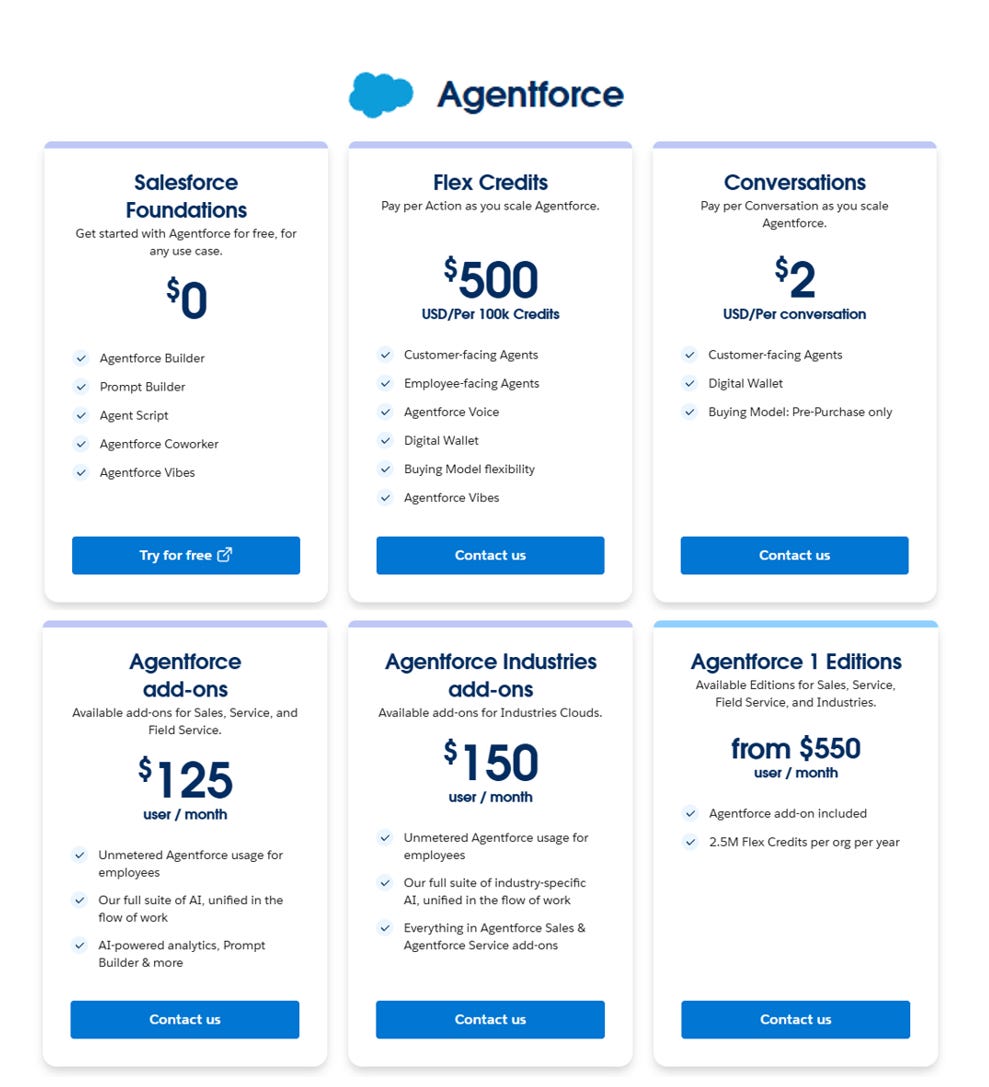
Importantly, rather than choosing or prioritizing one structure over others, all three pricing structures are concurrently available to customers, presumably with the flexibility to choose the one they want to use. Salesforce has reported strong traction across multiple-choice pricing structures, with Agentforce reaching $800 million in annual recurring revenue across a large customer base of over 29,000 deals since launch. Recently, the company has begun reporting a new measure, the so-called agentic work unit (AWU), defined as a single discrete task performed by an AI agent (e.g., a prompt, a reasoning chain, or invoking a tool). Note that, as of now, the correspondence between the AWU and the price is still unclear. What is clear is that it offers a future pathway to quote and realize prices that map to AI execution.
It is worth looking closely at what each of these three pricing structures does and does not capture, because the challenge Salesforce is dealing with is applicable to every AI product company. Charging per conversation is easy for the customer to understand, since a conversation is something a manager can contextualize. However, it treats every conversation as the same, losing significant variability that is relevant to an effective pricing strategy. A thirty-second password reset and a long, multi-step billing dispute have the same price tag, lacking price discrimination based on value delivered that is so important for an effective pricing structure.
Charging per action fixes this limitation because it captures the difficulty of the task and matches the price charged to the value delivered. However, by doing this, it moves away from pricing based on outcomes and back towards usage. Of the three current options, the per-user license pricing is the most predictable of the three and the easiest to budget for, but it is also the least connected to any result; it is a back to per-seat pricing, and the challenges associated with the human–AI labor distinction discussed earlier (and elsewhere). This concurrent multiple-price structure offering gets at the heart of the outcome-pricing challenge for AI products: Should the price be tied to a measure the customer can easily assess, or to something the customer actually values, when those two things keep turning out to be different?
Implications for those pricing AI products
As it stands today, the three cases illustrate that although outcome-based pricing is a promising pricing structure, well-suited to price the value delivered by AI products, it is still very much a work in progress. At the moment, the concept covers a range of outcomes, some of which are closer to customer value (e.g., a verified, closed conversation) and others are much further from it (e.g., a recommended lead). The closer the priced outcome gets to the essence of the customer value delivered by the product, the more successful outcome-based pricing will be. In such cases, it will be an exemplary form of value-based pricing. However, how far the priced outcome can depart from delivered value and still be viable is an open question and will determine how widely it is used.
The second issue with outcome-based pricing today is its inability to serve as a standalone pricing structure for an AI product. As we saw in the cases of both Zendesk and HubSpot, for very narrowly defined AI agent applications, such as customer conversations to answer their inquiries or provide support, it may be viable to use as the sole pricing approach. But as the Salesforce pricing moves suggest, anything even a bit broader requires it to be used in conjunction with other, more traditional and well-accepted pricing structures from the SaaS world. A hybrid price structure gives the customer a predictable base they can budget and the AI product vendor revenue it can rely on, while keeping a variable outcome component that links price to customer value. We are still in the early stages of working out how to price AI this way, and as AI agents take on broader, less bounded work, the role of outcome pricing is likely to narrow from the whole price to a single component of the price structure.
The definition of an automated resolution, the requirement that the AI handle the issue without human escalation, and the verification logic (including channel-specific inactivity windows of up to 72 hours) are drawn from Zendesk’s own documentation: “About automated resolutions for AI agents,” https://support.zendesk.com/hc/en-us/articles/5352026794010-About-automated-resolutions-for-AI-agents. Per-resolution figures (approximately $2.00 pay-as-you-go and $1.50 for committed volume) are corroborated by independent pricing analyses, which agree on these rates: https://www.eesel.ai/blog/zendesk-ai-dynamic-pricing-resolution and https://servicedeskagents.com/vs-zendesk/ (both verified April 2026); the 72-hour inactivity mechanism is described further at https://corepiper.com/blog/zendesk-ai-agent-pricing-2026/.
As far as I can tell, the time period depends on channel and plan. For some messaging cases, the default may be much shorter, with a maximum of 72 hours; for email and web forms, Zendesk describes a 72-hour window.
HubSpot announced the move to outcome-based pricing for both agents, including the $0.50-per-resolved-conversation and $1-per-recommended-lead rates and the shift away from per-conversation and per-contact billing, in its own company communications: “HubSpot’s Customer Agent and Prospecting Agent: Now you pay when the task is complete,” https://www.hubspot.com/company-news/hubspots-customer-agent-and-prospecting-agent-now-you-pay-when-the-task-is-complete (effective April 14, 2026). HubSpot’s definition of a resolved conversation, including the role of an inactivity window of up to 72 hours, is corroborated by independent analyses: https://martech.org/hubspot-moves-to-outcome-based-pricing-for-some-breeze-ai-agents/ and https://www.constellationr.com/insights/news/hubspot-price-breeze-customer-agent-breeze-prospecting-agent-outcomes.
Agentforce financial figures (approximately $800 million Agentforce ARR, up 169% year over year; over 29,000 deals since launch; and 2.4 billion Agentic Work Units delivered, the AWU being a productivity metric rather than a billing unit) are from Salesforce’s own Q4 FY2026 results: “Salesforce Delivers Record Fourth Quarter Fiscal 2026 Results,” https://www.salesforce.com/news/press-releases/2026/02/25/fy26-q4-earnings/, and the accompanying Form 8-K, https://investor.salesforce.com/. The three concurrent pricing models ($2 per conversation at launch, Flex Credits at roughly $0.10 per action from May 2025, and per-user licensing added in late 2025, now running simultaneously) are documented in independent pricing analyses: https://www.saastr.com/salesforce-now-has-3-pricing-models-for-agentforce-and-maybe-right-now-thats-the-way-to-do-it/ and https://www.jitendrazaa.com/blog/salesforce/salesforce-agentforce-credits-cost-model-complete-guide-2026/.