
The Double Conversion Problem in Credit-Based AI Pricing Models
Credit-based pricing helps AI vendors manage costs and complexity. But customers must first convert dollars to credits at purchase, and again credits to tasks at use, imposing burdens.

Summary. Credit-based pricing has become one of the most visible and fastest-growing pricing model for AI products. Its popularity arises from its ability to solve problems associated with other AI pricing models. For vendors, credits allow variable costs to be coupled to customer use, making the margin earned more predictable and reducing the risk of exploding costs. For customers, credits act as an intermediate currency, changing how value is evaluated, how the product is used, how purchases are budgeted, and how fairness is judged. In this piece, I explore the double-conversion problem with this pricing model: the dollar-to-credit conversion at purchase is visible and stable, but the credit-to-work conversion at use is variable, vendor-controlled, and often opaque. What the customer actually pays to use the AI service depends on this second, difficult conversion. Drawing on consumer research and current cases from Canva, Clay, HeyGen, GitHub, Windsurf, Adobe, and monday.com, I identify where credit-based pricing systems can potentially lose customer trust and provide seven principles for designing customer-friendly credit-based pricing models.

“Your theory is confined to that which is seen; it takes no account of that which is not seen.” - Frédéric Bastiat, politician and economist, 1850.
Introduction
Consider the following scenario. A marketing manager signs her team up for an AI design tool, which costs $13 per seat per month and includes 200 premium credits. This price seems reasonable and transparent. It is moderate, has a generous credit allowance, and a free trial that demonstrates the tool’s value. The first month passes without incident. In the second month, however, there are problems. Image generation draws down the credit allowance at one rate, but the tool has added a new conversational design agent that consumes credits at 13 times that rate. In one instance, producing a usable image requires five attempts, consuming five credits. The team’s credit allowance runs out before the end of the third week of that second month. The marketing team derives far less value in the second month, and the marketing manager is stumped.
As the case studies throughout this piece will illustrate, value erosion and a mismatch between expectations and results are common challenges for customers with credit-based pricing. Every credit-based model requires the customer to make two conversions. The first converts dollars into credits. This conversion is clear-cut; it is typically posted on the company’s website as the pricing schedule, doesn’t change all that much, and requires the customer to actively accept it when signing on. The second conversion occurs when the customer uses the service and converts credits into tasks, whether they are generating images, converting text to speech, acting on a prompt, or something else. This conversion can be problematic for the customer because it is task-dependent, can vary widely depending on the AI model used, and is subject to frequent adjustments by the vendor. What the buyer actually pays for services received depends mainly on this second conversion, with the first conversion serving as the cap on total services received and price paid. This is the double-conversion problem, which makes credit-based pricing opaque and difficult for customers to process, potentially leading to negative consequences for vendors and customers alike.
The strengths of credit-based pricing models
As I’ve discussed before in other posts, many AI service providers have tried to use pure-SaaS pricing models and have run into difficulties because of the significant differences in cost structures, particularly marginal costs, and scalability. A major challenge is the significant variable costs of providing AI services today, which make it very hard to simply adopt a SaaS model with minimal incremental costs. In the same way, per-seat pricing ignores what the AI actually does, a mismatch I examined in an earlier piece. And outcome-based pricing requires the vendor to define and verify outcomes, which, as I argued in the insurance piece, most are not yet equipped to do.
A credit-based pricing model bypasses these issues for AI vendors. It is versatile; credits can be used to offer a portfolio of services, with different conversion rates attached to each. Credits can be coupled to costs in a way that is completely opaque to the customer yet protective of margins. And perhaps most importantly, conversion rates can be tweaked quickly in response to pricing inputs such as costs or customer valuation, and new conversion rates can be added for new services, without changing the price the customer pays.
As the head of product monetization at an AI vendor recently put it to analysts at Metronome: “We don’t love credits, but we didn’t have time to define outcomes. This was the fastest way to ship.” Evidence of adoption also suggests that this pricing model is popular among AI vendors. According to one widely cited industry statistic drawn from a catalog of AI pricing models, credit-based pricing grew 126% year over year in 2025 (although we should acknowledge that the base was relatively low).
Credits as intermediate currencies
Now let’s consider the psychology behind the double conversion in credit-based pricing models. We can start with the fact that credits are essentially a form of “intermediate currency” that has existed in pricing models for decades, even centuries. Although they differ in some respects, casino chips, gift cards, loyalty points, and prepaid cards are all intermediate currencies that require the double conversion seen in credit-based pricing models. I want to consider four findings here from the accumulated research on intermediate currencies that carry over directly to AI credit-based pricing models. Each one describes a change in customer behavior that occurs from the nature of the currency rather than from the vendor’s offerings or marketing activities, or the customer’s needs.
1. Credits shift the customer’s attention from the value of the work to the state of the balance. Research on so-called “medium maximization” has found that when a medium, such as points, is placed between the consumer’s effort and the reward received, they begin to focus on the medium and try to optimize it, turning their attention away from the outcome it is supposed to represent. In the original experiments, participants reliably chose options that earned them more points but delivered objectively worse rewards1. Extrapolating this idea to AI pricing, medium maximization suggests that customers may focus much more on using up their allocated credits and less on what they use them for. Instead of the core issue of “Is this work worth doing?” or “How to do this work most effectively?”, credits bring the issue of “How can we use up these credits before they expire?” to the foreground.
2. Prepayment leads to a dedicated mental account, with mixed consequences for the AI vendor. Research on mental accounting shows that people do not treat money as fungible; they categorize it, track it by category, and evaluate spending against the relevant account rather than against their overall wealth2. The purchase of prepaid credit opens exactly such an account. Once the customer has paid for the AI service, the dollars are recategorized as already spent, and each subsequent task is charged against the credit balance rather than the wallet. This recategorization is a significant commercial advantage of credit-based pricing, because customers will often experiment with new or unfamiliar features on a prepaid balance that they would never buy individually for cash, leading to faster and more frequent trials of new capabilities and greater openness to innovation. This same mechanism, however, can also suspend the customer’s normal budgeting discipline. They will stop scrutinizing spending at the time of prepayment and become more attentive only when the next payment is due, which, as discussed below, can be problematic. What’s more, automated payment, annual plans, and relatively modest amounts are all likely to suppress the scrutiny even further.
3. Prepayment separates paying from consuming, but visible cues to credit use increase attention. Research on payment coupling shows that prepayment by customers weakens the psychological link between paying and consuming, which is why prepaid cards, such as gift cards, are spent more freely and with less deliberation than cash. Research on bundling further supports this story by showing reduced consumption. In one study, for example, buyers of multi-day ski passes skied on fewer of the days they had paid for because, once several units are rolled into a single advance payment, no single day of skiing feels individually significant3. Bundles of credits for AI services may function the same way, until cues about bundle use trigger customer attention. Many services have gamified credit use by doing things like displaying running balances, consumption rates, and threshold warnings, no doubt with good intentions, such as to minimize excessive use or sticker shock. But the net result is a pricing structure that combines the disadvantages of prepayment with those of metering. For customers, they’ve already spent the money for the service, so the spending no longer has the power to motivate their usage behavior; yet a tally or a countdown rations every individual customer action as though they were paying cash, one dollar bill at a time.
4. The magnitudes of the credit system are persuasive. Beyond purchasing power, customers also respond to the face value of a currency. Research on reward programs shows that the sheer size of the numbers a program uses shifts customers’ judgments of generosity, progress, and distance to a goal4. For example, an allowance of 2,000 credits for $9.99 feels abundant in a way that “ten dollars worth of usage” doesn’t, and a 5-credit charge for an action is interpreted as trivial even when it is hard for the customer to figure out how much that was in dollars and cents. The key lesson from this property of customer perception is that an intermediate currency need not be used strategically to confuse the customer. When the conversion between dollars and the currency is simple enough to do in one’s head, using an intermediate denomination can reduce the perceived cost of a purchase, implying that a credit-based pricing model does not need overly complicated ratios to deliver benefits to the vendor. Overly complicated ratios, which change often, on the other hand, may lead to frustration, dissatisfaction, and suspicion that the vendor is trying to manipulate them.
It is important to note that all of these effects are aspects of customer psychology; they do not require vendors to be strategic or manipulative in any shape or form. However, with this knowledge of psychology, the pricing practitioner now has decisions to make about how to deal with the psychological outcomes of credit-based pricing models, i.e., lean into them and benefit at the customer’s expense or alleviate their effects on customers.
The second conversion in credit-based pricing models
Next, let’s consider the two conversions in the credit-based pricing model in greater detail. The first conversion involving dollars to credits (i.e., how much should we charge and how many credits should be in exchange) is a direct and obvious pricing decision for the vendor, and is also the more visible of the two. It is available on the vendor’s website’s pricing page and is carefully evaluated by prospective customers. The second conversion, from credits into completed work, usually receives far less design attention. In the cases covered in this piece, for example, this conversion information is far less accessible, often to be found in the support documentation rather than on the pricing page. Yet this conversion forms the economic substance of the pricing structure and operates in three ways to shift value from the customer to the vendor.
First, the effort required to convert credits to completed work conceals the effective prices of different tasks. For instance, consider an AI video product in which a minute of processed video costs 20 credits with the premium AI model but only 3 credits with the standard previous-gen model. In pricing terms, the premium model carries a quality premium of nearly 7X, but whether it is worth it remains unclear to the customer, even after they have completed the task. What’s more, they never see or know the exact premium they paid in dollars and cents. The only way they will have any sense of what’s going on is when their credit allowance runs out much earlier than expected due to using the premium model. As should be clear, compared with other services, purchasing AI services with credit-based pricing models leaves the customer in the dark.
Second, credit-based pricing shifts the production risk from the vendor to the customer. Take the example of the sales-data platform Clay. Until March 2026, the company charged credits per enrichment attempt rather than per successful result, so a lookup that queried three data providers and didn’t yield useful results from any still consumed three lookups’ worth of credits. Industry observers estimated that failed lookups consumed 20 to 30 percent of a typical team’s monthly allocation5. Stated differently, customers bore the cost of unsuccessful attempts, regardless of why the attempt failed.
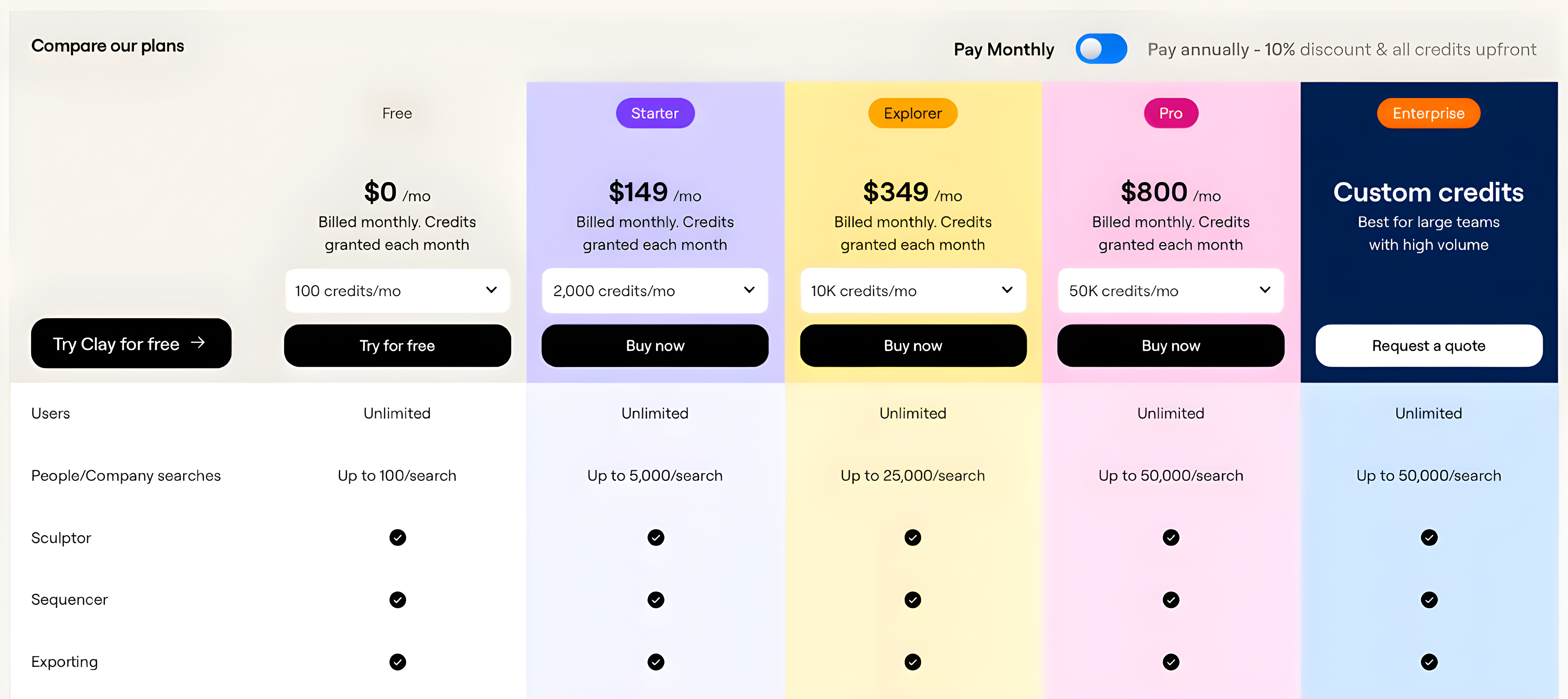
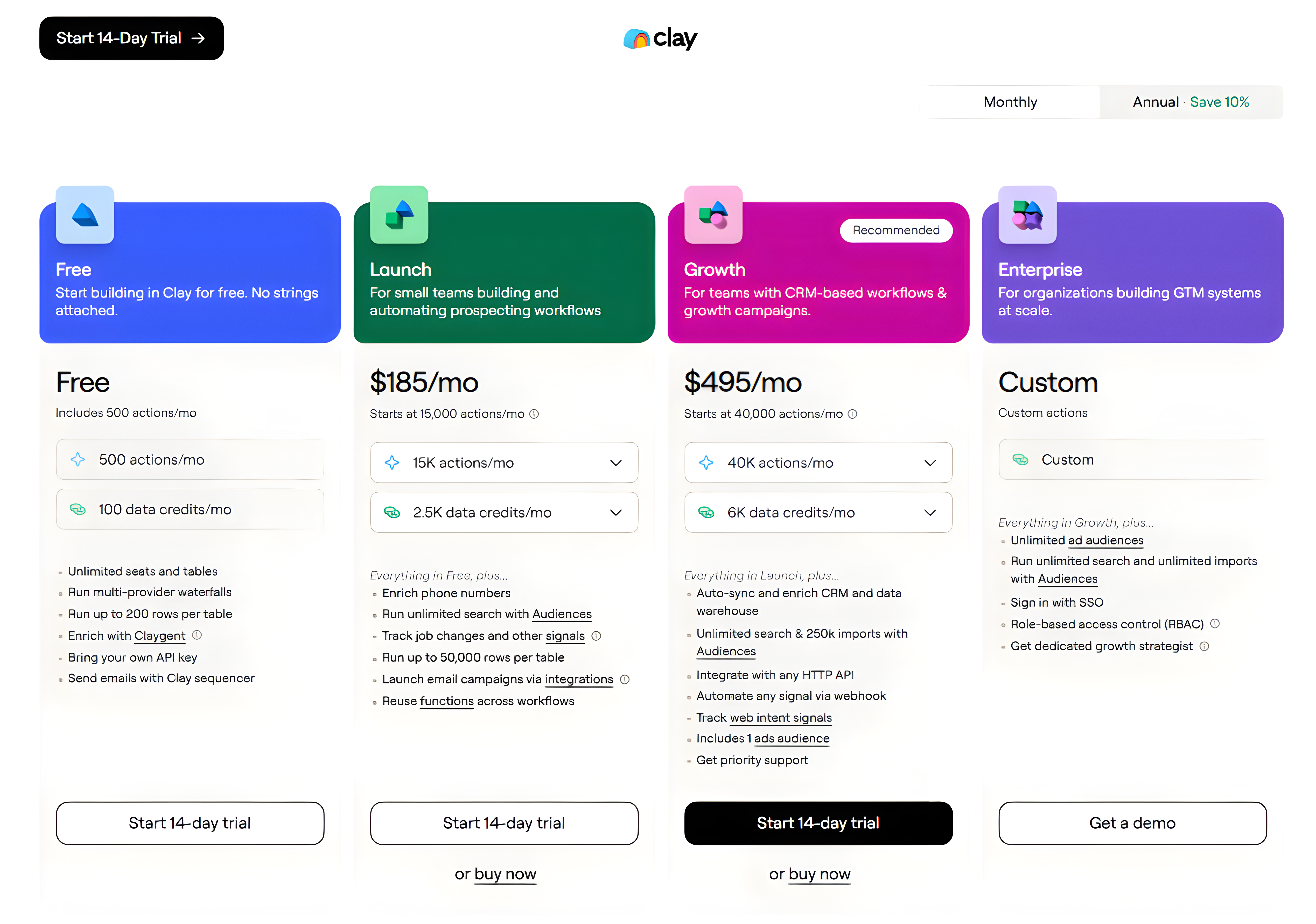
As I argued in the insurance piece, the risk that an AI system fails to produce the promised result is actually the vendor’s production risk. Whereas outcome-based pricing models retain the risk with the vendor, credit-based models transfer part or all of this risk to the customer. If this is not managed properly, say with full disclosure, it can backfire spectacularly. In Clay’s case, to its credit, the company reversed course during its March 2026 overhaul, adopting a no-result-no-charge rule and, remarkably, disclosing its internal pricing memo alongside the announcement with impressive transparency. Clay’s pricing page now explains that the plan thresholds were chosen to reduce customers’ anxiety about how usage affects their service spending. At the moment, most AI vendors do not pay this much attention to the customer-psychology impacts of their pricing strategies.
Third, credit-based pricing allows the AI vendor to adjust the realized price (the actual price the customer pays for tasks completed by the service) without changing the posted price. This is usually done when the vendor changes the number of credits a task consumes, adds more expensive (or, less often, cheaper) ways to perform the task using more advanced models, or adds new tasks to the repertoire of services delivered to customers. Each of these cases is tantamount to the list price remaining unchanged while the mix of on-invoice and off-invoice adjustments changes by a B2B vendor. Just as the off-invoice price components are invisible to all but the most observant and vigilant customers, so are the conversion ratios and their changes. Of the three functions of credit-based pricing models, this one is perhaps the most consequential, with the greatest potential to adversely affect customer welfare.
The weaknesses of credit-based pricing models
While pricing practitioners focus on the structural aspects of the pricing model, customers experience the pricing, and especially the double conversion problem, through tangible experiences. Looking across the credit-based pricing models currently in the market, the experiences that damage the customer relationship cluster into three recurring modes of customer difficulties: (1) the customer cannot tell what things cost while using the product, (2) the customer discovers that a credit buys less than it used to, and (3) the customer watches credits they paid for disappear unused. Additionally, these models also have the potential to create complications in B2B buying centers. These issues, considered next, have the potential to result in negative outcomes for AI vendors.
Opacity in use
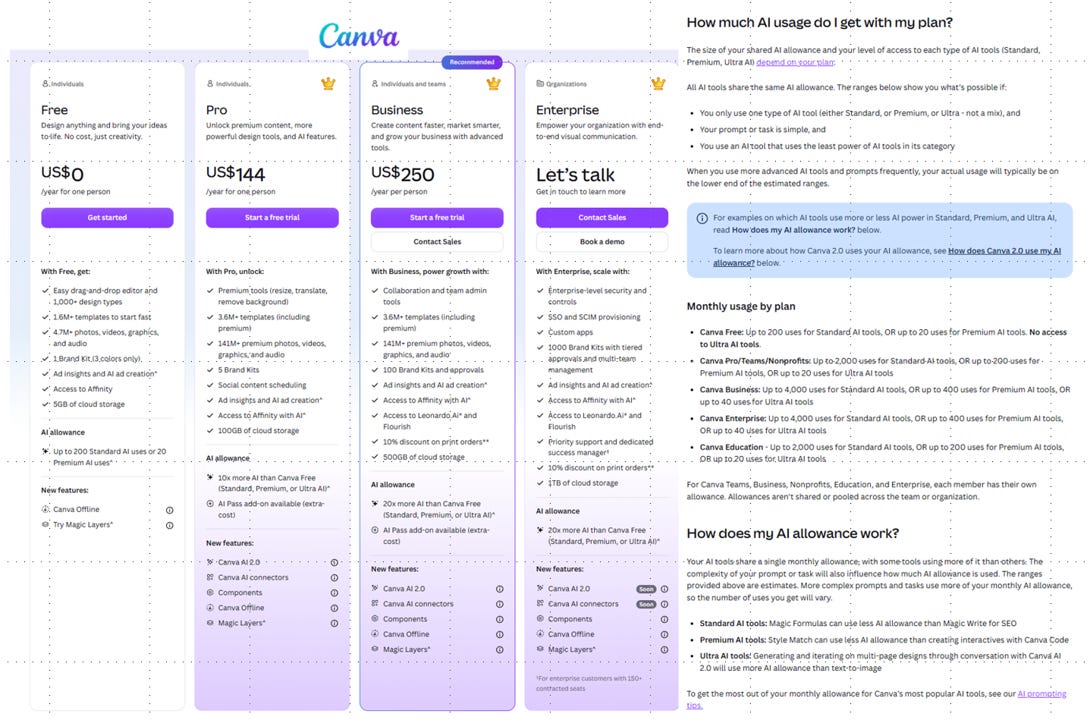
Consider Canva, which runs every AI feature from a single shared monthly allowance that depletes at three very different speeds. Standard tools draw down the credit allowance, premium tools draw it faster, and the conversational design agent consumes it at approximately a hundred times the rate of the basic tools, with failed generations counting in full. The most consistent complaint in Canva’s own community is that a month’s allowance can be easily exhausted from a weekend of experimenting6.
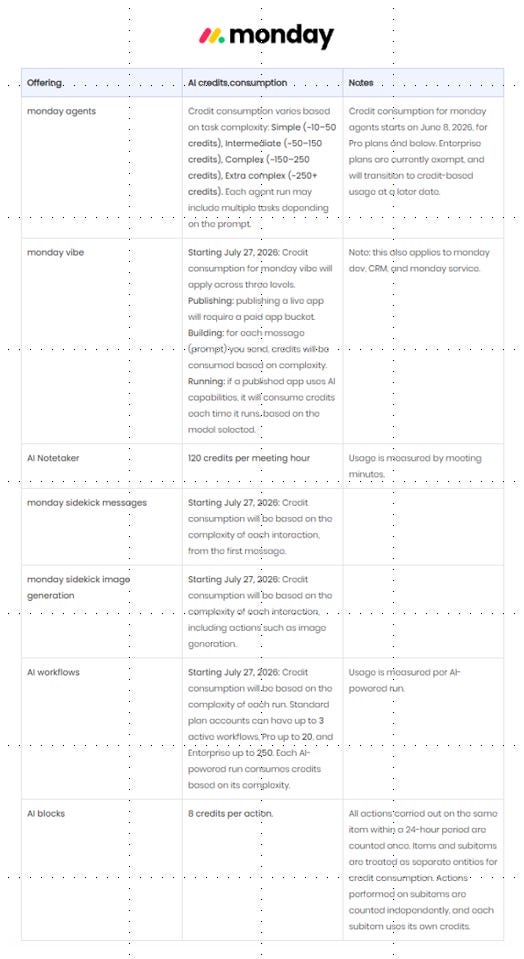
monday.com, the work-management platform designed to run projects, workflows, and CRM pipelines, illustrates a different form of the same problem. While Canva’s pricing accomplishes the same task with different tools that consume credits at varying rates, monday.com uses a single AI credit pool with different credit consumption rates for per-action automations, per-minute meeting notes, per-message chat, and complexity-priced agents. Thus, four different pricing schedules are encapsulated in a single credit-based pricing structure, something that is bound to be cognitively onerous for customers7.
As a third example of this opacity, HeyGen, the AI video platform that generates presenter-led videos from a script using synthetic avatars, prices in credits. Thus, a HeyGen customer who budgets its use of the AI service based on the older avatar model and then switches to the more recent premium one will deplete its allowance nearly seven times faster (i.e., there’s a 7X difference in credit consumption between the two models)8. These examples suggest that the default setting for credit-based pricing is opacity at the second conversion, with attendant customer difficulties.
Potential for devaluation without a posted price change
A problem inherent to every intermediate currency is that the seller retains discretion over its value. Changes usually take the form of devaluation: the price paid and the allowance of credits remain unchanged, but what a credit buys shrinks. There are several examples of this approach available already among AI vendors. GitHub Copilot made this change openly in June 2026, replacing flat request units with usage-weighted credits valued at one cent apiece. A long autonomous work session that previously consumed a single unit now draws down credits according to its full cost. Consequently, heavy users receive less work in the aggregate for the same monthly price9. Other vendors make such changes with far less disclosure. Industry surveys indicate that 37% of AI companies plan to change their pricing model within the next year10, and for a credit-priced product, the consumption schedule is the natural and least visible place for changes.
Consumer research provides some indication of how customers may respond to these devaluations. Research on loyalty programs, the longest-running private currencies in marketing and the closest thing we have to a history of credit-based pricing, shows that customers treat accumulated points as assets they own rather than as discounts they might receive in the future. A change in what a point buys is therefore experienced as a loss of something already possessed rather than as a new price for a future purchase. Research on price fairness perceptions provides consistent guidance, in that customers accept price increases they can attribute to the seller’s rising costs and punish increases that appear opportunistic or are concealed. Credit devaluation thus diminishes something the customer regards as their own, and because it arrives without announcement, its discovery is interpreted as concealment rather than price action. It is no surprise that such changes regularly produce public backlash, and on occasion, vendor retractions11.
About six weeks before GitHub announced its move to usage-weighted credits, the coding assistant Windsurf abandoned credits entirely. Under its previous structure, each prompt cost one credit from a monthly allowance, regardless of how much work it required. Thus, a two-word clarifying question cost customers the same amount as an hour-long autonomous coding task cost. Windsurf’s announcement describes what this pricing did to their customers’ behavior:
“Our previous credit-based billing model charged the same rate for both simple and complex requests. This led users to be scared of asking quick questions, knowing they’d consume the same credits as a lengthy, complex task. Many users felt pressured to cram multiple requests into single prompts rather than working interactively with the agent, ultimately degrading the quality of their Windsurf experience.
As models have improved, the variance in the length of each model turn has increased dramatically and the longest sessions can involve dozens of model calls. We believe this trend will continue, and we want you to focus on building, not on optimizing how to maximize the output from each request12.”
In March 2026, Windsurf replaced the monthly credit balance with usage allowances that refresh on a daily and weekly basis. Customers no longer have to preserve or exhaust their stored credits before the end of the month. Their usage is still metered, however. The amount consumed depends on the model selected, the complexity of the task, and the length of the session. A customer who reaches the daily limit may regain capacity when the daily limit refreshes, provided the weekly limit has not also been reached. Customers on paid plans can purchase additional usage, which Windsurf bills at the underlying model and task API prices.
Thus, two vendors selling similar products to similar customers reached different conclusions about how to translate usage into a customer-facing price. GitHub retained credits and made each request consume an amount that more closely reflects the work performed. Windsurf removed the visible credit balance and replaced it with daily and weekly usage limits, even though consumption still varies depending on the selected model and the complexity of the task. Both companies rejected the notion that every prompt has the same cost. They differed in whether customers should experience that variation through a stored currency or through periodically refreshed limits. That two sophisticated vendors redesigned the same basic pricing mechanism within months of each other, but chose different customer interfaces, shows how unsettled credit-based AI pricing remains. Windsurf’s decision is especially revealing because it was based on observed customer behavior. The company found that its pricing was discouraging short questions and interactive use by customers, and changed their pricing model to reduce that distortion.
Credit Expiration
Virtually every intermediate currency, including the credit-based offers of AI service vendors, produces breakage when balances or credits are not redeemed or are otherwise left unused by customers. Adobe’s terms as of this writing are prototypical:
“No, generative credits do not roll over to the next month. Your generative credit balance will reset to your allocated amount on a monthly basis. You can find your monthly reset date in your Account Menu anytime. Your monthly reset date is the day of the month on which you first initiated or were assigned your plan13.”
Thus, the expiration of credits nullifies the value of what the customer has paid for and expects to receive at the end of the stipulated term, and, psychologically speaking, an expiration date can backfire. Although well-meaning vendors may expect that the expiration deadline will encourage customers to use the service more to use up their remaining credits, research on gift cards suggests that consumers often actively postpone redeeming the card before a deadline, frequently lose the benefit, and then experience regret14.
Furthermore, customers also distinguish between monthly allowances and credits purchased as top-ups. While the former is seen as part of a pricing plan and therefore more reasonable to reset monthly, top-ups are seen as paid-for, owned assets, with expiration treated as appropriation or even confiscation.
Complications in B2B buying centers
In consumer settings, the person who pays for the product is typically also the person who uses it, connecting the purchase and consumption experiences. In B2B settings, in contrast, these roles are distributed across the buying center, and a credit-based price structure can widen the separation between them. For instance, procurement may approve the vendor’s asked-for price when signing the contract, and finance will review and process dollar-denominated invoices. The service’s users, however, interact with the product and consume it in terms of credits.
This separation can generate predictable conflicts among the members of the buying center. The managers advocating for AI adoption within the organization may want their reports to use the product freely, using up every single credit; indeed, the prepaid pricing structure supports this goal. The department head whose budget pays for the product, by contrast, wants predictable consumption, and the credit structure works against this goal because depletion cannot be reliably forecast when different tasks, models, and failure rates draw down a shared credit allowance at varying, often opaque rates. In practice, a small number of heavy users often exhaust a shared allowance well before the end of the period.
These frictions accumulate and become most visible at contract renewal. As I described in the contract renewal piece, AI contracts already receive heightened scrutiny at their first renewal, when procurement and finance have greater influence in a decision that was originally made by an enthusiastic champion. For contracts involving credit-based pricing models, this review becomes even more difficult because the organization must reconstruct, after the fact, who consumed the credit, for what purpose, and what outcomes were achieved. It may be very hard, time-consuming, and in some cases, infeasible to do this.
The implications for AI vendors are clear. For a credit-based pricing model to be effective, it must provide usage reporting that connects credit consumption to users, features, and completed work. Without such reporting, the renewal decision will rest on the customer’s impressions of value rather than on any documented evidence.
When credit-based pricing is justified, and when it is not
This discussion suggests that within the domain of pricing AI products, credit-based pricing models have a place, but the specific conditions under which they work well need to be understood by pricing decision makers. These conditions include, first, that the AI product covers heterogeneous tasks (e.g., transcribing meetings, drafting messages, and running multi-step agents) rather than a narrow homogeneous one. In the former cases, a less versatile pricing model would price one activity well while underpricing or overpricing the others. Second, credit-based pricing models work well for products that deliver hard-to-define value. Here, credits facilitate mapping customer value to dollars and cents by serving as the intermediate currency.
The third condition for these pricing models to work is that the vendor’s underlying costs should differ materially across tasks, so that a uniform price per task would systematically misprice at least some of them. The fourth condition is that the product is still evolving quickly enough that the vendor has a legitimate need to adjust prices frequently as capabilities and costs evolve. Finally, even when the other conditions hold, the structure is defensible only if the vendor makes the conversion visible at two points: (1) before the customer acts, by displaying what the action is expected to cost in credits, and (2) after the fact, through usage reporting that shows which features consumed the credits and what results were obtained. When these conditions are satisfied, credits essentially function as a portfolio currency, a single unit of account for an offering that sells many different capabilities and services.
Credit-based pricing is difficult to justify when these conditions are not met. For example, when a natural unit of value exists clearly in the customer’s mind and is used for evaluation and decision making, but the vendor either fails to understand or ignores this, credit-based pricing won’t fit well. In such cases, pricing based on these natural units of value, which are often outcomes like minutes of finished video, successfully enriched records, resolved cases, and completed documents, makes more sense.
This pricing model is also difficult to justify when the credit mechanism functions mainly to conceal price differences between tasks, when customers cannot predict how quickly their allowance will deplete, when the vendor changes consumption rates without treating those changes as price changes, or when the metering of credits penalizes customers for failed attempts, retries, or internal processing steps that are not clearly visible to the customer. An AI vendor can test which side of the fence they fall on using this simple test: remove the credit mechanism from your pricing structure and state your prices in menu form, clearly in dollars and cents, to complete the tasks your service delivers. If these prices seem unreasonable (too high, too low, inconsistent across the menu, and so on), then the credit-based pricing model is being used to camouflage more serious problems with your offering or business strategy. If they seem reasonable, you are good to go.
Seven design principles for credit-based pricing models
I will conclude this piece by briefly describing seven actionable design principles for those interested in using credit-based pricing models for their AI services.
1. Anchor credits to dollars and cents clearly.
Many vendors have made their credit-based pricing models overly complicated by making even the first conversion of dollars to credits hard to understand. Part of this complexity stems from credit-based pricing often being part of a larger hybrid pricing model. Whether it is part or the whole, the customer must be able to quickly, with a single glance, figure out the price they are paying per credit. This alleviates suspicion and increases trust in your pricing model.
2. Show the estimated cost incurred for each action beforehand.
As a point of price-execution hygiene, every credit-priced action should include an estimate of how many credits (and the corresponding dollars and cents) will be incurred, and this should be provided to the customer before they carry out the task.
3. The customer should not be charged for failed tasks.
This is a particularly relevant issue in many AI service settings, where outcomes are uncertain due to evolving technology and customer adoption. Consequently, the rule should be that if the task fails for whatever reason, the customer should incur a charge. It’s worth noting that this is bringing credit-based pricing into the domain of outcomes.
4. When conversion ratios for tasks are changed, the vendor should treat them as a price change for communication and account management.
As discussed throughout this piece, the double-conversion problem is primarily driven by the opacity of the second conversion. The guidance here is to make second conversions more transparent. This means that each time the vendor changes the conversion ratios that map credits to tasks, they should clearly explain these changes and the rationale behind them to the customer.
5. When available, use the natural unit of value as the frame for setting and explaining prices.
This is a general best practice for pricing communication, but it is especially relevant in the context of AI services. In many applications, there are natural units of customer value (which may or may not coincide with outcomes sought), such as minutes of video, number of records to be enriched, number of cases resolved, and so on. This makes communicating both conversions in a credit-based pricing model easier and more transparent, and aligns the value derived by the AI vendor and their customers.
6. Separate included credits from purchased credits.
When using a credit-based pricing model, it is imperative to distinguish between credits included in the subscription and credits the customer buys separately, and to accord them different properties, such as no expiration for purchased credits. The underlying principle is that customers shouldn’t feel they are being shortchanged or taken advantage of by the vendor.
7. Provide detailed usage reporting, itemizing credit usage to tasks completed at the user level.
This is another effective way to address the double-conversion problem and enhance the integrity of the credit-based pricing model. When the customer seeks details about how the credits are being used, usage reporting answers all relevant questions. This feature, provided as part of the AI service, is useful for various purposes across the organization and will facilitate future renewal conversations with the customer.
Hsee, C. K., Yu, F., Zhang, J., & Zhang, Y. (2003). Medium maximization. Journal of Consumer Research, 30(1), 1–14.
Thaler, R. H. (1985). Mental accounting and consumer choice. Marketing Science, 4(3), 199–214; Thaler, R. H. (1999). Mental accounting matters. Journal of Behavioral Decision Making, 12(3), 183–206.
On coupling and prepayment, see Prelec, D., & Loewenstein, G. (1998). The red and the black: Mental accounting of savings and debt. Marketing Science, 17(1), 4–28; Soman, D. (2001). Effects of payment mechanism on spending behavior. Journal of Consumer Research, 27(4), 460–474; Raghubir, P., & Srivastava, J. (2008). On Monopoly money: The effect of payment coupling and form on spending behavior. Journal of Experimental Psychology: Applied, 14(3), 213–225. On bundles and consumption, see Soman, D., & Gourville, J. T. (2001). Transaction decoupling: How price bundling affects the decision to consume. Journal of Marketing Research, 38(1), 30–44. On sunk payments losing force, see Gourville, J. T., & Soman, D. (1998). Payment depreciation. Journal of Consumer Research, 25(2), 160–174.
Bagchi, R., & Li, X. (2011). Illusionary progress in loyalty programs: Magnitudes, reward distances, and step-size ambiguity. Journal of Consumer Research, 37(5), 888–901; Drèze, X., & Nunes, J. C. (2004). Using combined-currency prices to lower consumers’ perceived cost. Journal of Marketing Research, 41(1), 59–72.
Clay’s March 11, 2026 overhaul, including the no-result-no-charge rule, the division into Data Credits and Actions, and the published internal pricing memo, is documented at https://www.clay.com/pricing and analyzed at https://michaelsaruggia.com/blog/clay-pricing-change-2026. The estimate that failed lookups consumed 20–30% of monthly allocations under the prior per-attempt rule is from https://www.cleanlist.ai/blog/2026-03-12-clay-pricing-changes-2026.
Canva’s shared allowance with Standard, Premium, and Ultra consumption tiers, the charging of failed generations, and the multi-step consumption of Canva AI 2.0 are documented in independent pricing analyses verified June 2026: https://www.eesel.ai/blog/canva-ai-pricing and https://checkthat.ai/brands/canva/pricing.
monday.com’s AI Credit definitions and its 80%/100% usage notifications are from the company’s documentation: https://support.monday.com/hc/en-us/articles/29544502265746-AI-Credits.
HeyGen’s credit plans and the Avatar III versus Avatar IV consumption differential are from HeyGen’s help center: https://help.heygen.com/en/articles/15125761-heygen-credit-based-pricing-plans-explained.
GitHub Copilot’s June 1, 2026 move from flat premium request units to usage-weighted AI Credits with a disclosed value of one cent per credit is documented in GitHub’s changelog and analyzed at https://tokenmix.ai/blog/github-copilot-ai-credits-billing-2026 and https://www.digitalapplied.com/blog/github-copilot-ai-credits-billing-2026-cost-audit-playbook.
ICONIQ’s 2026 State of AI benchmarking, cited at https://credyt.ai/blog/ai-credit-system.
On stockpiling and the asset-like treatment of points, see Stourm, V., Bradlow, E. T., & Fader, P. S. (2015). Stockpiling points in linear loyalty programs. Journal of Marketing Research, 52(2), 253–267. On fairness, see Bolton, L. E., Warlop, L., & Alba, J. W. (2003). Consumer perceptions of price (un)fairness. Journal of Consumer Research, 29(4), 474–491; Kahneman, D., Knetsch, J. L., & Thaler, R. H. (1986). Fairness as a constraint on profit seeking. American Economic Review, 76(4), 728–741.
Windsurf’s March 19, 2026, announcement, including the statement that flat credits made users afraid to ask quick questions and pressured them to combine requests into single prompts, is the company’s own: https://devin.ai/blog/windsurf-pricing-plans/. The earlier removal of per-action charging in favor of one credit per prompt is also the company’s own announcement: https://devin.ai/blog/pricing-v2.
Adobe’s no-rollover policy and expiration rules are from the company’s documentation: https://helpx.adobe.com/creative-cloud/apps/generative-ai/generative-credits-faq.html. The customer complaint about purchased credits expiring is from Adobe’s community forum: https://community.adobe.com/questions-404/generative-fill-credits-1476891. Customers may be more likely to regard separately purchased top-ups as owned balances than to view monthly included credits that way.
Shu, S. B., & Gneezy, A. (2010). Procrastination of enjoyable experiences. Journal of Marketing Research, 47(5), 933–944.